
Zero-knowledge proofs (ZKPs) are a fascinating concept in cryptography that allow one party, known as the prover (P), to convince another party, the verifier (V), that a statement is true without revealing any additional information. A classic analogy used to illustrate this concept is the “Ali Baba Cave” scenario, which effectively demonstrates the principles of ZKPs while maintaining the confidentiality of sensitive information.
The Ali Baba Cave Scenario


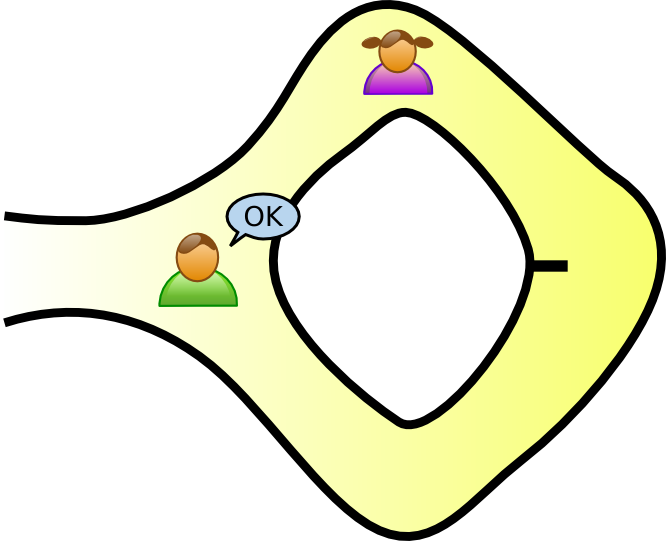
In this analogy, imagine a circular cave with a door that can only be opened with a secret password. The cave has two paths, C and D, leading to the door. The verifier, V, stands at point A outside the cave, while the prover, P, knows the password and is inside the cave.
- Initial Setup: P enters the cave and chooses one of the two paths (C or D) to approach the door. V does not see which path P takes.
- Verification Process: Once P is inside the cave, V moves to point B and randomly asks P to exit from either path C or D.
- Proving Knowledge: If P knows the password, they can open the door and exit from whichever path V requests. If P does not know the password, they can only exit from the same path they initially chose, making it impossible to consistently satisfy V’s requests over multiple rounds.
- Repeated Trials: This process is repeated multiple times (typically 10-20 rounds). Each time V asks P to exit from a random path, P’s chances of successfully guessing correctly without knowing the password are 50%. However, as the number of rounds increases, the probability that P is merely guessing diminishes significantly. For example, after 20 rounds, the chance of successfully deceiving V drops to approximately 1 in $2^{20}$, or about 1 in a million.
Key Properties of Zero-Knowledge Proofs
The Ali Baba Cave analogy encapsulates three essential properties of ZKPs:
- Completeness: If P knows the password, they can always convince V that they possess this knowledge.
- Soundness: If P does not know the password, they cannot consistently deceive V over multiple rounds.
- Zero-Knowledge: Even after interacting with P, V learns nothing about the password itself; they only gain confidence that P knows it.
Limitations and Misinterpretations
While this analogy serves as an excellent introduction to ZKPs, it is important to note its limitations. For instance, if V were to record all interactions on video, this would not constitute proof for a third party that P knows the password. This is because both parties could have pre-arranged which paths would be asked for each round. Thus, even with video evidence, it does not guarantee that P possesses genuine knowledge of the secret.
Moreover, some interpretations simplify this analogy too much by suggesting that merely knowing how to unlock a door suffices as a zero-knowledge proof. However, true ZKPs require a more complex interaction where V remains unaware of any specific details about P’s knowledge beyond their ability to demonstrate it through repeated trials.
Conclusion
The Ali Baba Cave analogy effectively illustrates how zero-knowledge proofs function in cryptography by demonstrating how information can be verified without being disclosed. This principle has significant implications for privacy and security in various applications such as blockchain technology and secure communications. Understanding ZKPs through such analogies not only aids in grasping their mechanics but also highlights their importance in modern cryptographic practices.